Abdul Hakim Murad
..Women’s functions vary widely in the Muslim world and in Muslim history. In peasant communities, women work out of doors; in the desert, and among urban elites, womanhood is more frequently celebrated in the home. Recurrently, however, the public space is rigorously desexualised, and this is represented by the quasi-monastic garb of men and women, where frequently the colour white is the colour of the male, while black, significantly the sign of interiority, of the Ka‘ba and hence the celestial Layla, denotes femininity. In the private space of the home these signs are cast aside, and the home becomes as colourful as the public space is austere and polarised. Modernity, refusing to recognise gender as sacred sign, and delighting in random erotic signalling, renders the public space ‘domestic’ by colouring it, and makes war on all remnants of gender separation, crudely construed as judgemental.
For Muslims, a significant development in the new feminism is the renewed desire for apartness. Contemplating the crisis of egalitarian social contracts, where the burden of divorce invariably bears most heavily upon women, Daly and many others advocate an almost insurrectionist refusal of contact with the male, and the creation of ‘women’s spaces’ as citadels for the cultivation of a true sisterhood. This cannot be immediately useful to Muslims. Hermeneutics of suspicion directed against either sex are irreligious from the Qur’anic perspective. God, as a sign, ‘has created spouses for you, from your own kind, that you may find peace in them; and He has set between you love and mercy.’ (30:21) Nonetheless, the feminist demand for apartness should not be cast aside; it may even converge significantly with Islam’s provision of it.
Other aspects of Shari‘a discourse also call for elucidation. It cannot be our task here to review the detailed provisions of Islamic law, and to explain, in each individual instance, the Islamic case that gender equality, even where the concept is meaningful, can be undermined rather than established by enforced parity of role and rights. Such a project would require a separate volume of the type attempted recently by Haifa Jawad; and we must content ourselves with surveying a few representative issues.
Perhaps the most immediately conspicuous feature of Muslim communities is the dress code traditional for women
 Perhaps the most immediately conspicuous feature of Muslim communities is the dress code traditional for women. It is often forgotten that the Shari‘a and the Muslim sense of human dignity require a dress code for men as well: in fully traditional Muslim societies, men always cover their hair in public, and wear long flowing garments exposing only the hands and feet. In Muslim law, however, their awra is more loosely defined: men have to cover themselves from the navel to the knees as a minimum. But women, on the basis of a hadith, must cover everything except the face, hands and feet.
Again, the feminine dress code, known as hijab, forms a largely passive text available for a range of readings. For some Western feminist missionaries to Muslim lands, it is a symbol of patriarchy and of woman’s demure submission. For Muslim women, it proclaims their identity: many very secular women who demonstrated against the Shah in the 1970s wore it for this reason, as an almost aggressive flag of defiance. Franz Fanon reflected on a similar phenomenon among Algerian women protesting against French rule in the 1950s. For still other women, however, such as the Egyptian thinker Safinaz Kazim, the hijab is to be reconstrued as a quasi-feminist statement. A woman who exposes her charms in public is vulnerable to what might be described as ‘visual theft’, so that men unknown to her can enjoy her visually without her consent. By covering herself, she regains her ability to present herself as a physical being only to her family and sorority. This view of hijab, as a kind of moral raincoat particularly useful under the inclement climate of modernity, allows a vision of Islamic woman as liberated, not from tradition and meaning, but from ostentation and from subjection to random visual rape by men. The feminist objection to the patriarchal adornment or denuding of women, namely that it reduces them to the status of vulnerable, passive objects of the male regard, makes no headway against the hijab, responsibly understood.
A further controversy in the Shari‘a’s nurturing of gender roles centres around the institution of plural marriage.
A further controversy in the Shari‘a’s nurturing of gender roles centres around the institution of plural marriage. This clearly is a primordial institution whose biological rationale is unanswerable: as Dawkins and others have observed, it is in the genetic interest of males to have a maximal number of females; while the reverse is never the case. Stephen Pinker notes somewhat obviously in his book How the Mind Works: ‘The reproductive success of males depends on how many females they mate with, but the reproductive success of females does not depend on how many males they mate with.’
Islam’s naturalism, its insistence on the fitra and our authentic belongingness to the natural order, has ensured the conservation of this creational norm within the moral context of the Shari‘a. Polygamy, in the Islamic case, appears as a recognisably Semitic institution, traceable back to an Old Testament tribal society frequently at war and unequipped with a social security system that might protect and assimilate widows into society. However it is more universal: classical Hinduism permits a man four wives, and there are many Christian voices, not only Mormons, who are today calling for the restoration of polygamy as part of an authentically Biblical lifestyle. (See, for example, http://www.familyman.u-net.com/polygamy.html)
Islam’s theology of gender thus contends with a maze, a web of connections which demand familiarity with a diverse legal code, regional heterogeneity, and with the metaphysical no less than with the physical. This complexity should warn us against offering facile generalisations about Islam’s attitude to women. Journalists, feminists and cultivated people generally in the West have harboured deeply negative verdicts here. Often these verdicts are arrived at through the observation of actual Muslim societies; and it would be both futile and immoral to suggest that the modern Islamic world is always to be admired for its treatment of women. Women in countries such as Saudi Arabia, where they are not even permitted to drive cars, are objectively the victims of an oppression which is not the product of a divinely-willed sheltering of a sex, but of ego, of the nafs of the male.
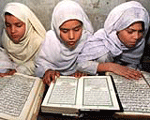
Muslim women have for long periods of Islam’s history left their homes to become scholars.
Biology should be destiny, but a destiny that allows for multiple possibilities. Women’s discourse valorizes the home; but Muslim women have for long periods of Islam’s history left their homes to become scholars. A hundred years ago the orientalist Ignaz Goldziher showed that perhaps fifteen percent of medieval hadith scholars were women, teaching in the mosques and universally admired for their integrity. Colleges such as the Saqlatuniya Madrasa in Cairo were funded and staffed entirely by women. The most recent study of Muslim female academicians, by Ruth Roded, charts an extraordinary dilemma for the researcher:
‘If U.S. and European historians feel a need to reconstruct women’s history because women are invisible in the traditional sources, Islamic scholars are faced with a plethora of source material that has only begun to be studied. [ . . . ] In reading the biographies of thousands of Muslim women scholars, one is amazed at the evidence that contradicts the view of Muslim women as marginal, secluded, and restricted.’
Stereotypes come under almost intolerable strain when Roded documents the fact that the proportion of female lecturers in many classical Islamic colleges was higher than in modern Western universities. A’isha, Mother of Believers, who taught hadith in the ur-mosque of Islam, is as always the indispensable paradigm: lively, intelligent, devout, and humbling to all subsequent memory.
Conclusion: Muslim Societies Today
But until past ideals are reclaimed, a polarisation in Muslim societies is likely. The Westernised classes will reject traditional idioms simply because those styles are not Western and fail to satisfy the élite’s self-image. The pseudosalafi literalists will continue to reject Sufism’s high regard for women, and its demand for the destruction of the ego. The same constituency will defy legitimate calls for a due ijtihad-based transformation of aspects of Islamic law, not because of any profound moral understanding of that law, but because of a hamfisted exegesis of usul and because those calls are associated with Western influence and demands.
Whether the conscientious middle ground, inspired by the genius of tradition, can seize the initiative, and allow an ego-free and generous Muslim definition of the Sunna to shape the agenda in our rapidly polarising societies, remains to be seen. No doubt, the Sufi insight that there is no justice or compassion on earth without an emptying of the self will be the final yardstick among the wise. But it is clear that the Islamic tradition offers the possibility of a truly radical solution, offering not only to itself but to the West the transcendence of a debate which continues to perplex many responsible minds, contemplating an emergent society where the absence of roles presides over an increasingly damaging absence of rules.
Read full paper:
http://www.masud.co.uk/ISLAM/ahm/gender.htm
'Islam, Irigaray, and the retrieval of gender'
©Abdal Hakim Murad (April 1999)
Brief biography of Shaykh Abdul Hakim Murad (Timothy J. Winter):
http://baytunur.blogspot.com/2010/02/perceived-failure-of-traditional.html
..Women’s functions vary widely in the Muslim world and in Muslim history. In peasant communities, women work out of doors; in the desert, and among urban elites, womanhood is more frequently celebrated in the home. Recurrently, however, the public space is rigorously desexualised, and this is represented by the quasi-monastic garb of men and women, where frequently the colour white is the colour of the male, while black, significantly the sign of interiority, of the Ka‘ba and hence the celestial Layla, denotes femininity. In the private space of the home these signs are cast aside, and the home becomes as colourful as the public space is austere and polarised. Modernity, refusing to recognise gender as sacred sign, and delighting in random erotic signalling, renders the public space ‘domestic’ by colouring it, and makes war on all remnants of gender separation, crudely construed as judgemental.
For Muslims, a significant development in the new feminism is the renewed desire for apartness. Contemplating the crisis of egalitarian social contracts, where the burden of divorce invariably bears most heavily upon women, Daly and many others advocate an almost insurrectionist refusal of contact with the male, and the creation of ‘women’s spaces’ as citadels for the cultivation of a true sisterhood. This cannot be immediately useful to Muslims. Hermeneutics of suspicion directed against either sex are irreligious from the Qur’anic perspective. God, as a sign, ‘has created spouses for you, from your own kind, that you may find peace in them; and He has set between you love and mercy.’ (30:21) Nonetheless, the feminist demand for apartness should not be cast aside; it may even converge significantly with Islam’s provision of it.
Other aspects of Shari‘a discourse also call for elucidation. It cannot be our task here to review the detailed provisions of Islamic law, and to explain, in each individual instance, the Islamic case that gender equality, even where the concept is meaningful, can be undermined rather than established by enforced parity of role and rights. Such a project would require a separate volume of the type attempted recently by Haifa Jawad; and we must content ourselves with surveying a few representative issues.
Perhaps the most immediately conspicuous feature of Muslim communities is the dress code traditional for women

Again, the feminine dress code, known as hijab, forms a largely passive text available for a range of readings. For some Western feminist missionaries to Muslim lands, it is a symbol of patriarchy and of woman’s demure submission. For Muslim women, it proclaims their identity: many very secular women who demonstrated against the Shah in the 1970s wore it for this reason, as an almost aggressive flag of defiance. Franz Fanon reflected on a similar phenomenon among Algerian women protesting against French rule in the 1950s. For still other women, however, such as the Egyptian thinker Safinaz Kazim, the hijab is to be reconstrued as a quasi-feminist statement. A woman who exposes her charms in public is vulnerable to what might be described as ‘visual theft’, so that men unknown to her can enjoy her visually without her consent. By covering herself, she regains her ability to present herself as a physical being only to her family and sorority. This view of hijab, as a kind of moral raincoat particularly useful under the inclement climate of modernity, allows a vision of Islamic woman as liberated, not from tradition and meaning, but from ostentation and from subjection to random visual rape by men. The feminist objection to the patriarchal adornment or denuding of women, namely that it reduces them to the status of vulnerable, passive objects of the male regard, makes no headway against the hijab, responsibly understood.
A further controversy in the Shari‘a’s nurturing of gender roles centres around the institution of plural marriage.
A further controversy in the Shari‘a’s nurturing of gender roles centres around the institution of plural marriage. This clearly is a primordial institution whose biological rationale is unanswerable: as Dawkins and others have observed, it is in the genetic interest of males to have a maximal number of females; while the reverse is never the case. Stephen Pinker notes somewhat obviously in his book How the Mind Works: ‘The reproductive success of males depends on how many females they mate with, but the reproductive success of females does not depend on how many males they mate with.’
Islam’s naturalism, its insistence on the fitra and our authentic belongingness to the natural order, has ensured the conservation of this creational norm within the moral context of the Shari‘a. Polygamy, in the Islamic case, appears as a recognisably Semitic institution, traceable back to an Old Testament tribal society frequently at war and unequipped with a social security system that might protect and assimilate widows into society. However it is more universal: classical Hinduism permits a man four wives, and there are many Christian voices, not only Mormons, who are today calling for the restoration of polygamy as part of an authentically Biblical lifestyle. (See, for example, http://www.familyman.u-net.com/polygamy.html)
Islam’s theology of gender thus contends with a maze, a web of connections which demand familiarity with a diverse legal code, regional heterogeneity, and with the metaphysical no less than with the physical. This complexity should warn us against offering facile generalisations about Islam’s attitude to women. Journalists, feminists and cultivated people generally in the West have harboured deeply negative verdicts here. Often these verdicts are arrived at through the observation of actual Muslim societies; and it would be both futile and immoral to suggest that the modern Islamic world is always to be admired for its treatment of women. Women in countries such as Saudi Arabia, where they are not even permitted to drive cars, are objectively the victims of an oppression which is not the product of a divinely-willed sheltering of a sex, but of ego, of the nafs of the male.
Muslim women have for long periods of Islam’s history left their homes to become scholars.
Biology should be destiny, but a destiny that allows for multiple possibilities. Women’s discourse valorizes the home; but Muslim women have for long periods of Islam’s history left their homes to become scholars. A hundred years ago the orientalist Ignaz Goldziher showed that perhaps fifteen percent of medieval hadith scholars were women, teaching in the mosques and universally admired for their integrity. Colleges such as the Saqlatuniya Madrasa in Cairo were funded and staffed entirely by women. The most recent study of Muslim female academicians, by Ruth Roded, charts an extraordinary dilemma for the researcher:
‘If U.S. and European historians feel a need to reconstruct women’s history because women are invisible in the traditional sources, Islamic scholars are faced with a plethora of source material that has only begun to be studied. [ . . . ] In reading the biographies of thousands of Muslim women scholars, one is amazed at the evidence that contradicts the view of Muslim women as marginal, secluded, and restricted.’
Stereotypes come under almost intolerable strain when Roded documents the fact that the proportion of female lecturers in many classical Islamic colleges was higher than in modern Western universities. A’isha, Mother of Believers, who taught hadith in the ur-mosque of Islam, is as always the indispensable paradigm: lively, intelligent, devout, and humbling to all subsequent memory.
Conclusion: Muslim Societies Today
But until past ideals are reclaimed, a polarisation in Muslim societies is likely. The Westernised classes will reject traditional idioms simply because those styles are not Western and fail to satisfy the élite’s self-image. The pseudosalafi literalists will continue to reject Sufism’s high regard for women, and its demand for the destruction of the ego. The same constituency will defy legitimate calls for a due ijtihad-based transformation of aspects of Islamic law, not because of any profound moral understanding of that law, but because of a hamfisted exegesis of usul and because those calls are associated with Western influence and demands.
Whether the conscientious middle ground, inspired by the genius of tradition, can seize the initiative, and allow an ego-free and generous Muslim definition of the Sunna to shape the agenda in our rapidly polarising societies, remains to be seen. No doubt, the Sufi insight that there is no justice or compassion on earth without an emptying of the self will be the final yardstick among the wise. But it is clear that the Islamic tradition offers the possibility of a truly radical solution, offering not only to itself but to the West the transcendence of a debate which continues to perplex many responsible minds, contemplating an emergent society where the absence of roles presides over an increasingly damaging absence of rules.
Read full paper:
http://www.masud.co.uk/ISLAM/ahm/gender.htm
'Islam, Irigaray, and the retrieval of gender'
©Abdal Hakim Murad (April 1999)
Brief biography of Shaykh Abdul Hakim Murad (Timothy J. Winter):
http://baytunur.blogspot.com/2010/02/perceived-failure-of-traditional.html