Pages

Showing posts with label Islamic Civilization. Show all posts

Thursday, October 21, 2010

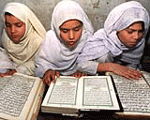
Seek Knowledge! An Obligatory Duty for Muslims!

1. Published: Friday, 26 January, 2007, 10:52 AM Doha Time

Prophet Muhammad sallallaahu 'alaihi wa sallam said: “Seeking knowledge is obligatory upon every Muslim.” (Related by Ibn ‘Adiyy, Al-Bayhaqi and Al-Tabarani). 

Though this Hadith is known and memorised by most Muslims, the essence, the amount, and the kind of knowledge referred to in this Hadith remains misunderstood by many. What are the minimum teachings that every Muslim – male or female – is required to know about his Deen?

A. Types of knowledge in Islam
Muslim scholars classify knowledge into two categories:

1: Obligatory knowledge (fardh ‘ayn): This refers to knowledge of the fundamentals of Islamic beliefs which every Muslim must know. Seeking this knowledge is an obligatory duty upon every Muslim. All obligatory knowledge deal exclusively with al-’Ilm al-Shar’i, that is, knowledge pertaining to Islamic faith, acts of worship, and the necessary transactions in the daily dealings of a Muslim.

2: Optional knowledge (fardh kifayah): This is not a duty required of every individual, but rather it falls upon the community as a whole. Hence, if a group of individuals in the community undertake to acquire this kind of knowledge, all other individuals will be exempted from this duty, and the whole community will be free from responsibility or negligence to acquire this kind of knowledge. Examples of such knowledge include studying Islamic law and other basic sciences, industries and professions which are vital for the welfare of the society.

Unlike obligatory knowledge, optional knowledge covers part of Islamic knowledge and all worldly knowledge. The former is called al-’Ilm al-Shar’i al-Kifa’i (optional Islamic knowledge), while the latter is called al-’Ilm al-dunyawi (worldly knowledge).
a) Religious sciences: These cover all branches of Islamic shari’ah, such as: tafseer (Qur’anic exegeses), fiqh, hadith sciences (known as mustalah al-hadith or ‘Ilm usul al- hadith), seerah (the Prophet’s biography), Islamic political science, (As-siyasah al- shar’iyah), Islamic history, etc.

Each of these sciences may require knowledge of other sciences to cover fully and comprehensively the substance of the matter studied. For example: tafseer needs Arabic grammar, Arabic literature, and other linguistic skills; Hadith sciences need the science of criticism (which looks at the narrators’ credibility, trustworthiness, power of memorisation, etc), called ‘Ilm al-jarh wat-ta’deel.

b) The natural and applied sciences: These are all the basic sciences, industries and professions which are of vital necessity for the welfare of the community. Examples of such fields include: engineering; agriculture, fisheries, food sciences, etc. Leaders of every Muslim community should always do their best to procure the necessary number of scholars, professionals and qualified men and women in all fields of optional knowledge needed by the community. For example, Muslims in a non-Muslim country must train sufficient number of shari’ah scholars to answer questions raised by members of the community. They must also prepare enough educators – administrators, teachers and counsellors to fill the growing needs of Islamic schools in this country. Both male and female Muslim doctors are needed in every city to care for male and female Muslim patients, respectively.
From the above discussion, we can fully understand the responsibility that lies upon the shoulders of Muslims in this continent.

Minimum requirements for Islamic sciences

First, the understanding fundamentals of Iman: This is also called ‘Ilm Usul ud-Deen (Fundamentals of Deen), or ‘Ilm al-Tawheed (the Oneness of Allah), or simply ‘Aqeedah (Islamic faith). Every Muslim must have a general knowledge of all matters pertaining to his faith. He should have a clear understanding of the Lord he worships, the Prophet he follows and the Deen to which he committed himself. Needless to say, one should exert the best of one’s effort to acquire these fundamentals.

Second, understanding Islamic rules and conduct (fiqh al-ahkam): This is also called fiqh al-’Ibadat (understanding of acts of worship). This field covers all aspects of the Islamic acts of worship that are necessary for the correct practice of one’s Salat, Zakat, Sawm, and Haj.
It als covers all aspects of family issues, such as marriage, divorce, children’s education, as well as rules and regulations for one’s business transactions such as, buying, selling, borrowing lending, etc. A Muslim is obligated to learn from fiqh al-ahkam only matters that are related to Ibadah (worship) he need to perform; and rules of a particular transaction he wants to undertake. For example, if a Muslim has not reached the age for prayer or fasting, he does not have to learn about them though he may be encouraged to do so. Also, if one does not have the necessary means to perform Haj, one does not need to learn its rituals until one becomes able to undertake the Haj journey.

By learning those two branches, a Muslim will know His Lord by all His beautiful names and Most High attributes. He will know the status, function and rights of the Prophets. He will follow a similar course when dealing with other required beliefs, such as the belief in the Angels, the Books, the Predetermined Decree, the Last Day, the punishment in the grave, etc. On the other hand, before performing any act of worship, a Muslim should know the requirements, the conditions and the desirable actions pertaining to that act. Hence, He will never practice any act of worship or undertake any transaction not sanctioned by the Qur’an or Sunnah.

Just by contemplating the Islamic knowledge of Muslims today, the reader can realise how much those two disciplines, which are required of every Muslim, have been neglected, if not totally ignored.

Unfortunately, there are many Muslim professors, doctors, and engineers, who hold the most advanced academic or professional positions in their respective institutions, yet do not possess the minimum knowledge of the Islamic sciences. Ironically, while it takes only a few weeks or even a few days to acquire the obligatory Islamic knowledge, it may take at least two years to obtain a basic degree in any worldly field.

Indeed, it is through knowledge and sincerity that one can enter paradise. This is how we can understand the Hadith of our beloved Prophet sallallaahu 'alaihi wa sallam, “Whoever adopts the path of seeking knowledge, Allah eases for him the way to Paradise.” (Related by Ahmad, Al-Tirmidhi, Abu Dawud, Ibn Majah, and Al-Darami).

The following Hadith is a strong reminder for anyone of us whom Allah has blessed with some Islamic knowledge: “Whoever is asked about a knowledge that he knows about and then hides it and keeps it away, he
will be bridled on the Day of Judgment with a bridle of fire.” (Related by Ahmad, Abu Dawud 
and Al-Trimidhi).

2. Friday speech delivered by Imam Mohamed Baianonie at the Islamic Center or Raleigh, NC on January 21, 2000

Knowledge is the road to Iman belief, and leads the person to fear Allah (S.W.T.). The fear, that is based on knowledge, regulates the person's deeds. Knowledge is the one that leads to fear of Allah, which in turn entices action. Allah (S.W.T.) said in surat Fatir, (Verse 28), what can be translated as, "It is only those who have knowledge among His slaves that fear Allah." Because of that, Allah (S.W.T.) brought the people of knowledge to different higher levels according to their knowledge, For that reason Allah (S.W.T.) raised up the degree of those who have knowledge, He (S.W.T.) said in surat Al-Mujadilah, (Verse 11), what can be translated as, "Allah will exalt in degree those of you who believe, and those who have been granted knowledge."

Knowledge of deen gathers and contains all righteous deeds and it is a sign of acceptance and pleasure of Allah (S.W.T.) with His servant. Imams Bukhari and Muslim reported that the prophet Muhammad (S.A.W.) said: "If Allah wants to do good to a person, He makes him understand and learn the deen."

Knowledge comes before Ibadah and regulates it, so no Ibadah is accepted unless it is based upon correct knowledge. For this reason, the prophet (S.A.W.) considered the person of knowledge to have much higher status than the worshipper. 

The prophet Muhammad (S.A.W.) elevated the one who has knowledge over the worshiper, He (S.A.W.) said in a good hadith reported by Imam At-Tirmithi,"An ‘Aalim (learned person in the deen) is as much superior to an ‘Aabid (Worshiper) as I am superior to the lowest among you." In another hadith reported by Imam Abu-Dawoud and At-Tirmithi, that the prophet Muhammad (S.A.W.) said: 

"An ‘Aalim (learned person in the deen) is as much superior to an ‘Aabid (Worshiper) as the full moon is superior to all stars."

The prophet (S.A.W.) considered seeking knowledge obligatory upon every Muslim, male or female. His teaching included all with no exception. Even the women took their share in seeking knowledge. Imam Bukhari reported that some woman requested the prophet (S.A.W.) to fix a day for them as the men were taking all his time. On that he promised them one day for lessons, so he preached and commanded them…"

Shyness did not prevent the women from seeking knowledge. Imam Bukhari reported that A'isha (R.A.) said: "The best woman are the woman of ansar because their shyness did not stop them from learning the deen."

The companions of the prophet were very eager to seek knowledge. They use to ask the prophet about every matter in their lives, and the prophet (S.A.W.) used to answer them with what Allah (S.W.T.) had taught him with humbleness and kindness.

The companions of the prophet (S.A.W.) used to alternate and rotate going to the Masjid of the prophet (S.A.W.) so that they do not put off their worldly work and nothing of seeking knowledge slips away. 

Umar (R.A.) is one example. Imam Bukhari reported that Umar Bin Alkhattab (R.A.) said: "My Ansari neighbor and I used to live far away from the masjid of the prophet (S.A.W.), and we used to visit the prophet (S.A.W.) by turns. He used to go one day and I go another day. When I went I used to bring him the news of that day regarding the revelation and other thing, and when he went, he used to do the same for me…"

Even the Bedouins used to travel a long distance to Madinah to seek knowledge by asking the prophet (S.A.W.). Imam Bukhari reported that Dimam bin Tha'labah came riding on a camel. He made his camel kneel down in the mosque, tied its foreleg and then said: "Who amongst you is Muhammad? At that time the prophet was sitting among his companions leaning on his arm. The companions replied, "This white man leaning on his arm. The man then addressed him. "O son of Abdl Muttaleb, I want to ask you something and will be hard in questioning. So do not get angry. The prophet said: "Ask whatever you want…" (Then the Bedouin, asked him many questions, and the prophet (S.A.W.) answered them all.)

The prophet (S.A.W.) ordered his companions who learned to teach others even if it is little. Imam Bukhari reported that the prophet Muhammad (S.A.W.) said: "Convey on my behalf even if it is only a verse (of the Qur'an)…"

Also Imam At-Termithi reported a good hadith that the prophet Muhammad (S.A.W.) said: "May Allah prosper the affairs of a person who hears something from us and communicates it to others exactly as he has heard it. Many a man to whom something is convened retains it in his memory and understands it better than the one who has heard it."

The prophet (S.A.W.) warned from keeping knowledge secret. 

Imams At-Tirmithi and Abo Dawud reported a good hadith that the prophet Muhammad (S.A.W.) said: "He who is asked about knowledge and conceals it, will be bridled with a bridle of fire on the Day of Resurrection."

The companions of the prophet (S.A.W.) were keen on seeking knowledge and spreading it during the life of the prophet (S.A.W.) and after. They traveled in the land to teach people and became within less than a quarter of a century the strongest Ummah on the face of the earth with what they had carried from the knowledge of deen and the knowledge the worldly life. With that, they became prosperous and the whole humanity became prosperous. This prosperity remained for so many centuries that history could not ignore. Many scientific remains in all aspects of science are still around.

Regression of this Muslim Ummah then started sometime in its history. This regression closely accompanied the attitude of laziness and carelessness and turning away from knowledge, so ignorance started to spread in place of knowledge until this Ummah became the most backward Ummah.

To revive this Ummah and empower it again with knowledge and leadership that it once had, we must spread the correct knowledge of the deenuAllah (S.W.T.) because from this knowledge stems all other knowledge. And it is a must that we take practical steps to achieve this.

We ask Allah (S.W.T.) to help us to seek knowledge and to bless us with sincerity in our sayings and deeds. O Allah! Increase our knowledge. "Ameen

Thursday, September 30, 2010

The Muslims Struggle for Islam is also Their Struggle to Preserve Their Cultures

Excerpts from a paper by Dr. Ejaz Akram

[Do not cite or reproduce from the following paper without permission of author]

A Definition of Culture


[Hence, in the light of the above ] I would like to present a definition of culture as “a realm of shared beliefs, ideas and symbols”. Inasmuch as culture is a medium between human beings, it also plays the part of binding individuals together, or that which binds humans with other humans. Non-material and higher aspects of cultures promote unity and cohesiveness in and across cultures, while the material side of culture such as geography and ethnicity often cause fragmentation.

Religion  AND Culture: Traditional & Modern Culture: Proximity & Distance from God

Traditional cultures are by and large religious cultures. 

It may be possible to find anti-religious or agnostic people and even small scale intellectual movements in the traditional world, but ultimate legitimacy of things in traditional cultures has always come from religion. Modern culture and cultures are exceptional in a sense that for the first time in human history they have managed to produce a secular ‘culture’ whose referent is not God and whose legitimacy comes not from proximity but distance from God. In a worldview that either denies the existence of God or relegates references to God as a backward form of human consciousness, it becomes possible to assert that all human behavior is socially and culturally determined, and culture alone is upheld to be the producer of the values it lives by.

Culture as a medium
Traditionally only religion has had the right to know cultures, inform the medium of culture of religious truth and want to see cultures as a reflection of itself. Only in modern times culture has equipped itself to look at not only itself but also religion. In that sense, it would be safe to assert that religious humans have a say on matters of culture while culture lacked the ability to do the same. This is because culture is a medium, it will carry in itself whatever one puts in it and people will only transmit across generations that which is of value, that what brings happiness, felicity, peace, and that which avoids pain, suffering and anguish. For the traditional man, it is religion that accomplishes the above and for the modern man, it is often the absence of religion that supposedly accomplishes that.

Religions views culture as its repository
Religion views culture as its repository. The ultimate source of religion is God, and God is out of the confines of time and space. The humans on the other hand are bound by time and space. The law, ethics, morality and rituals of religion are meant for those that live in the human abode. God is above humans and God’s knowledge seeks to inform the way people live in their earthly abode. In this sense, religion seeks to inform culture with perennial principles that are a key to leading a good life. 

Religions thus leave their imprints on human cultures. 

History of humanity is also a history of religions. There is nothing in the world that has nothing to do with religion. Religions have always sought to guide humanity towards cultivating cultures that uphold ‘thou must not kill’ and ‘thou must not deceive’. World religions always seek to regulate human behavior so that there is peace among humans.

In religious worldview, the marriage of religion and culture would be like the marriage of Heavens and Earth or the marriage of man and woman. The former representing the absolute and active principle while the latter is the reflection of the former as a receptacle:

“A traditional civilization, such as that of Islam, is dominated by a Divine Norm, by a ‘presiding Idea’ which leaves its profoundest imprint upon its earthly receptacles; yet each receptacle is given the freedom to develop its own innate possibilities within the tradition into which it is integrated and hence to give birth to a particular ‘world’ or ‘zone’ within the general matrix of the tradition in question”.[15]

Traditional religion views traditional cultures as its repository. 


Modern religion (different types of fundamentalisms, especially revisionist Islam in its salafi form) are uncomfortable with the concept of culture because in its worldview religion should be pure and pristine while culture is seen as a polluting agent that has corrupted religion. 

In the Islamic tradition, Muslim scholars have viewed traditional cultures with the terminology of ‘urf.[16] Ibn Khaldun, the famous 14th century philosopher calls the study of societies (and their cultures) ilm al umran.[17] In the Islamic philosophic tradition, the relationship between traditional religion and traditional cultures was a symbiotic one in which ‘urf was informally considered by many doctors of law as a legitimate source of Islamic law.

The word ‘urf in Arabic means human customs, conventions, practices and social habits.[18] It comes from the same root word as irfan or ilm al ma’arifa which implies higher and Gnostic knowledge. 

Muslims' struggle for Islam is also Their Struggle to Preserve their Cultures

All religions are first and foremost traditions. There is nothing intrinsically modern about religion. Like the institution of family, religion is also a traditional institution. Out of all living religions, Muslims are still arguably closest to their religion and constitute the last remaining frontier that modernism vies to engulf and dissolve. 


The Muslims’ struggle for Islam is also their struggle to preserve their cultures as receptacles of Divine words.

According to S. H. Nasr:

“Islamic culture displays an undeniable unity which is the result of the spirit and form of the Islamic revelation and ultimately of Divine Unity itself. In the same way that the whole created order is the theophanic reflection of the One in the mirror of multiplicity, so are the various ‘faces’ of Islamic culture so many human echoes of the one Message which is itself beyond the human and which alone bestows upon the activity of a human collectivity the purposes and values which make it worthy of being called a culture in conformity with the noble destiny of man”.[28]


Read more by and about Dr. Ejaz Akram http://baytunur.blogspot.com/2010/06/modernism-secularism-evolution-culture.html

Saturday, August 14, 2010

Friday, August 6, 2010

Islamic Civilization: "The Colossal Loss of the Colonial Period"

THE OXFORD HISTORY OF ISLAM
Ed. John L. Esposito,
Reviewed by Maryam Jameelah
As the Holy Prophet and the Qur’an were the final culmination and re-affirmation of all the previous religious Traditions, so did the early Muslims regard themselves as the only rightful heirs to all the civilizations of antiquity. This inspired a tremendous love for knowledge and quest for learning wherever it could be found. The translation of the major Greek, Persian, Indian (and much later, Chinese) classics on science and philosophy into Arabic and their gradual Islamization, was one of the most important events in the history of human civilization. No external military or economic pressures were involved to explain this momentous development, but only love of knowledge for its own sake.
Illuminating chapters discuss the rich Islamic heritage in Africa, China and South-East Asia, replying to the often-asked question if culture can be separated from religion? The fact is, one is inseparable from the other as no culture can grow in a void. Hence the traditional Chinese, the African, the Indo-Pak and Malaysian expressions of Islamic culture are all equally valid. Islam was never intended to be a uniform monolith but the embodiment of unity in diversity. Never intended to achieve and earthly utopia, despite all imperfections and failings, traditional Islamic civilization provided maximum stability, equilibrium and collective support for the individual Muslim in his quest for eternal salvation.
In a brilliantly revealing chapter, Dr. Syed Vali Reza Nasr, Professor of Political Science at San Diego University, presents the colonial and post-colonial period as a colossal loss, both to Muslims themselves and to the world at large which may prove beyond repair and irreversible. He shows how the colonial heritage has decisively shaped the present post-colonial Muslim-majority, anti-Islamic national-states with their emphasis on western-style “Development” and top-down state-managed social and cultural transformation in the modern western image, - a direct successor to the colonial “white-man’s burden” and his “civilizing” mission to “improve” the “natives.”
The final chapter on Islam today by Esposito himself shows how Muslims did survive the colonial mayhem, though with terrible spiritual and cultural impoverishment, illustrated by the preceding chapter on Islam in the modern West.
After suffering discontinuity from their heritage by two centuries of alien colonialism, it is hardly surprising when youth today attempt to re-connect, they easily lose their way (see illustration on p. 673)
This book is an eloquent presentation of the incredible richness and depth of traditional Islamic civilization throughout the world from its inception to the present-day.

Friday, July 30, 2010

"Not About Islam as Religion, About A Universe Recognizably Islamic"

Ali A. Allawi

The Crisis of Islamic Civilization

"This book is not about Islam as religion or as a code of outer conduct and transactions. This book is about Islamic civilization, a universe that is recognizably Islamic."

 One of The Globalist's Top Books of 2009.
Islam as a religion is central to the lives of over a billion people, but its outer expression as a distinctive civilization has been undergoing a monumental crisis. Buffeted by powerful adverse currents, Islamic civilization today is a shadow of its former self. The most disturbing and possibly fatal of these currents—the imperial expansion of the West into Muslim lands and the blast of modernity that accompanied it—are now compounded by a third giant wave, globalization.

These forces have increasingly tested Islam and Islamic civilization for validity, adaptability, and the ability to hold on to the loyalty of Muslims, says Ali A. Allawi in his provocative new book. While the faith has proved resilient in the face of these challenges, other aspects of Islamic civilization have atrophied or died, Allawi contends, and Islamic civilization is now undergoing its last crisis.

The book explores how Islamic civilization began to unravel under colonial rule, as its institutions, laws, and economies were often replaced by inadequate modern equivalents. Allawi also examines the backlash expressed through the increasing religiosity of Muslim societies and the spectacular rise of political Islam and its terrorist offshoots. Assessing the status of each of the building blocks of Islamic civilization, the author concludes that Islamic civilization cannot survive without the vital spirituality that underpinned it in the past. He identifies a key set of principles for moving forward, principles that will surprise some and anger others, yet clearly must be considered.

Ali A. Allawi has served as Minister of Defense and Minister of Finance in the Iraqi postwar governments. The author of the highly praised Occupation of Iraq, he is senior visiting fellow at Princeton University.

Sunday, July 4, 2010

Answering the Question How Do We Catch China!

Dr. Muzaffar Iqbal

Invoking the name of an Ibn Sina, or a Razi, they [Muslims] attempted to prove that Islamic civilization did have its great scholars, sages and scientists. No one was interested in reclaiming this veritable tradition, they were all interested in inheriting it.

Thus stultified, this invocation to the past glory did nothing but sooth the burning pain of that generation of Muslims who came just before the end of the colonial period. For when the struggle for independence started, its point of departure was based on the transformed societies which were already looking toward the West for guidance and help. Most leaders of these movements were actually the products of the Western institutions.

They had already accepted the judgment and everything that came with it: the state as the basic operating unit, their own nation as the alpha and omega of their political ambition, western-style education including its science and technology as the mantra of progress, western political and economic institutions as the operating apparatus of the state and the western judiciary as the system of justice. Thus independence was essentially a change of rulers rather than ideologies.

But even within these movements [of resurgence], little has been accomplished in terms of understanding the nature of western science.

For the most part, modern western science was accepted without any critical evaluation of its philosophical foundations, its claims, its goals and its ultimate worldview. The nineteenth century illusion of science being a value-free, objective discipline became the reigning paradigm in the Muslim world, and it remains so, even after its demise in the West. This blind acceptance begot an equally blind demand for science. 

From the political leadership to the reformers and from the common man in the street to the opinion leaders, everyone agreed that the Muslim world needs to catch up with the West in science and technology. I recall the most recent resolutions adopted in this very city by the Organization of Islamic Conference which repeated this broken record as part of its routine repetitious and fruitless calls which have been making rounds since the early eighties. In fact, the mantra of the political leadership in countries as far apart as Morocco and Pakistan and the writings of the opinion leaders throughout the Muslim world—all incessantly demand more and more science. It is another matter that in their blissful innocence, they confuse technology with science and even when they mean science, they usually mean the applied sciences. Thus, it is not surprising that in public discourse about science in the Muslim world, the phrase most often used is “science and technology”, in one breath, without a pause.

This is not a new situation. Since the time of the nineteenth century modernist reformers, the general opinion in the Muslim world has been that the West was able to advance and colonize almost the entire Muslim world because of its science and technology, both spoken of as if they are one. This line of thought has given birth to the “catching up syndrome”—the idea that as soon as the Muslim world acquires science and technology, it will catch up with the West. This has been articulated over and over and with such regularity that it has become the gospel of development strategies.

Considering the global impact of modern science, perhaps it is not unwarranted that Muslims should be so enthralled by it. In addition, there are the obvious needs of contemporary Muslim societies which force reliance on western science and its products. These range from genetically altered seeds to telecommunication, from defense needs to pharmaceuticals and from consumer goods to essential chemicals. In fact, for all practical purposes, the whole of the Muslim world, comprising one fourth of human beings now living on planet earth, is utterly dependent on the western science.

This dependency is not the artificial dependency of the elite for consumer goods; rather, this is a fundamental dependence on western science in almost all areas of life—from agriculture to pharmaceutical products and from communication to industrial chemicals—is increasing. In this, the Muslim world shares its predicament with other non-Western countries.

Those who think that modern science and its sister, technology, will find cure to the problems they have created without the help of religion live in a world of illusions. Just as thought cannot get out language and fact cannot be independent of theory, a system cannot transcend its own boundaries.

For all those who are concerned with the spiritual and physical well-being of humanity, the daunting task at this stage is to forge anew an inalienable link between the two formidable forces that shape our lives: science and religion. Only through such an inalienable link, can we hope to travel on a path that is rightfully ours—a path envisioned for the human race through a binding covenant that made us the vicegerents of God, the Creator of the whole cosmos Who chose in His infinite Mercy and Knowledge to place us here on this earth as trustees with enormous responsibilities.