Donald McClelland, U.S. Agency for International Development
The long-standing debate over the impact of religion on economic growth particularly the current debate over the impact of Islamic thought on the economic prospects of Muslim countries—parallels similar debates over the impact of Catholicism, Hinduism, and other religions. These debates have not had much impact on development practice, partly because of their inconclusive nature.
The issue addressed in this paper is whether Islam, as the “religion of practice” in a wide range of countries, poses serious problems for economic growth or whether the undeniably poor economic performance of many Muslim countries stems from sources unrelated to Islamic theology and practice.
Recognizing the tension between progressive and moderate practitioners of Islam and their fundamentalist challengers—a tension that often spills into the political arena—the paper concludes that most Muslim countries face very difficult governance issues that have impeded rapid economic growth
Why do Muslims tend to be relatively poor? The facts are undisputed: Muslims make up 19 percent of the world’s population but earn only 6 percent of its income. The issue is whether there are any causal relationships between religion and economic development. Many scholars suggest that religion is typically not a problem, pointing out that Islamic beliefs and values that appear inimical to growth (e.g., the ban on interest and restrictions on speculation) are routinely circumvented. The corporation is now an acceptable and popular organizational form in most Muslim countries. Insurance contracts are legally enforceable. Banks are integral components in every Muslim country’s economy.
And contracts involving interest payments are commonplace, although payments are sometimes disguised as commissions or fees.
Others believe there are deeper problems. Characterizing an Islamic economic system—
“Islamic economics”— as a middle ground between capitalism and socialism, they cite the Koran’s overriding emphasis on the need for social justice; rejection of severe economic disparities; condemnation of economic exploitation, usury, and dishonesty; call on well-to-do individuals to use part of their wealth to help the poor and support various charitable endeavors; and repeated expressions of concern for those least capable of defending themselves against poverty. Despite the Koran’s emphases, proponents of Islamic economics argue that it can effectively promote both economic development and social welfare in predominantly Muslim countries.
It seems clear that the economic institutions Islamic law prevented—corporate law, banks, stock markets, modern firms, insurance—are all integral parts of most economies of the Muslim world. As a result, economic policy reforms needed to accelerate economic growth in the Muslim world could be adopted without having to confront Islam as a religion.
Although Islam harbors elements inimical to economic productivity and efficiency, these have not formed an absolute barrier to economic growth. In fact, Noland’s recent analysis (2003) of India, Malaysia, and Ghana provides empirical evidence that there is no consistent, systematic relationship between economic growth and the share of a country’s population practicing Islam. He concludes that the impact of Islam on short-run economic performance is as diverse as Islam itself.
The Muslim world is extensive and diverse, comprising 48 countries where at least 50 percent of the population is Muslim. It extends from West Africa (Morocco and Mauritania) to East Asia (Indonesia). The larger Islamic world includes several countries with a significant Muslim minority. India is the most prominent of these countries with a Muslim minority of over 125 million people (12 percent of the population). Others include Kazakhstan, with almost 8 million Muslims (47 percent of the population), and Uganda, with almost 4 million Muslims (16 percent of the population). In France, nearly 6 million people are Muslim (about 10 percent of the French population).
The top five Muslim-country recipients of USAID economic assistance over the five-year period 1997–2001 were Egypt, Jordan, West Bank/Gaza, Indonesia, and Bangladesh. In 2002, Pakistan and Turkey were among the top five recipients; Indonesia and Bangladesh were not, though they were still among the top 10. The top five recipients of USAID assistance per capita in 2002 included Albania, Kyrgyzstan, Egypt, Jordan, and West Bank/Gaza.
Khan (1999) zeros in on the crux of the issue, asking how would one know what an Islamic economy looks like if there has never been one. He draws a sharp distinction between Islamic countries as political entities, of which there are many, several with very deep historical roots, and Islamic economies, where historical experience is thin. The examples of the latter usually cited—Afghanistan under the Taliban, Iran under the Revolutionary Council of Ayatollah Khomeini, and Sudan under Hassan al-Turabi—certainly give cause for concern that Islamism can be a vehicle for economic growth and improved standards of living. According to MSI (2002), the reason seems deeply rooted in the nature of Islam:
First, economics is, at best, of secondary importance to Islamists. It does not feature prominently in their political agenda, or in the books, articles and pamphlets that emanate from Islamist circles. Islamist thinkers, politicians, and activists are clearly far more concerned with matters of morality, ethics, and piety than with economic questions. Some even express contempt for economics. As Ayatollah Khomeini once remarked when pressed to address economic issues, “the revolution is about Islam, not about the price of melons.” Islamism is driven first by culture (the search for a “moral order,” consistent with God’s will for mankind, as revealed in the Koran) and, second, by politics (the quest for controlling the levers of power that will make it possible to
establish that moral order). Economic concerns are far less central to Islamist thinking and strategizing; they come well after cultural and political objectives.
To understand the impact of Islam on economic growth in Muslim countries, it is necessary to understand this challenge from Islamism and the links between economics and politics (economic governance). Although it is probably fair to say that Islam per se is not a significant impediment to improved economic performance in any Muslim country (Annex 1), it can be a contributing factor.
According to Jabber (2002), poor economic performance in so many of these countries is one of the three basic causes of widespread alienation of the populations of Muslim countries from their governments. This alienation in turn supports fundamental Islamism, which is the main challenge to political authority in Muslim countries. And Islamism’s political challenge— often using violent means—undermines the basic economic environment needed to improve investment returns and to stimulate higher standards of living.
From this perspective, analyses of what went wrong economically in the Muslim world have focused on immediate or proximate causes, rather than deep and fundamental causes. Abed’s review (2003) for the IMF of the Middle East and North Africa region, for example, provides an extensive litany of policy failures and poor governance as the reasons for their “unfulfilled promise.” Islam is not mentioned even once as a factor associated with these problems.
Similarly, a USAID review of lessons learned from USAID and other donor experience in providing economic assistance to selected Islamic countries never mentions Islam as a contributing factor to the success or failure of the ten specific projects reviewed. Moreover, neither the IMF nor the USAID review provides guidance on how to fix poor policies or improve governance, when both may well be held hostage to the political challenge from fundamental Islamists. Specific actions for possible support by USAID are identified at the conclusion of this report.
PETER TIMMER: In addition to his faculty positions in three schools at Harvard, Timmer has also held professorships at Cornell and Stanford. In 1992, he received the Bintang Jasa Utama (Highest Merit Star) from the Republic of Indonesia for his contributions to food security. He served as the chief outside advisor to USAID for developing their strategy on growth and agriculture for the Natsios Report (Foreign Assistance in the National Interest), and he was one of the key advisors for the World Development Report 2008: Agriculture for Development. He currently serves as an advisor to the Bill and Melinda Gates Foundation on agricultural development and food security issues.
Some Statistics as Annex in this report:
Annex 1. Countries in the Muslim World1
Middle East and North Africa (18)
Algeria
Bahrain
Egypt
Iran
Iraq
Jordan
Kuwait
Lebanon
Libya
Morocco
Oman
Qatar
Saudi Arabia
Syria
Tunisia
United Arab Emirates
West Bank/Gaza
Yemen
Europe and
Eurasia (7)
Albania
Azerbaijan
Kyrgyzstan
Tajikistan
Turkey
Turkmenistan
Uzbekistan
South Asia (4)
Afghanistan
Bangladesh
Maldives
Pakistan
East Asia and
the Pacific (3)
Brunei
Indonesia
Malaysia
Africa (16)
Burkina Faso
Comoros
Chad
Djibouti
Eritrea
Ethiopia
Gambia
Guinea
Mali
Mauritania
Niger
Nigeria
Senegal
Sierra Leone
Somalia
Sudan
Agrarian Economies (21) Oil Producers (22) Neither (9)
Ethiopia Albania Turkey
Burkina Faso Algeria Uzbekistan
Niger Azerbaijan Kyrgyzstan
Guinea Bahrain Maldives
Mali Brunei West Bank/Gaza
Chad Egypt Lebanon
Tajikistan Iran Jordan
The Gambia Iraq Morocco
Eritrea Kuwait Djibouti
Comoros Libya
Senegal Malaysia
Somalia Oman
Afghanistan Qatar
Nigeria Nigeria
Sudan Sudan
Sierra Leone Saudi Arabia
Bangladesh Syria
Yemen Yemen
Indonesia Indonesia
Mauritania Tunisia
Pakistan Turkmenistan
United Arab Emirates1
1. Member of OPEC (10)
2. Both agrarian and oil producing
Note: Agrarian economies are Muslim countries where at least 50 percent of employment is in the agriculture sector; oil producers are Muslimcountries that are members of OPEC and/or Muslim countries categorized in the exporters of crude oil or oil and petroleum products.
Source: CIA Factbook, 2002.
Agriculture Industry Services
Middle East and North Africa
Algeria 8.8 59.7 31.5
Bahrain
Egypt 16.7 33.1 50.2
Iran 17.7 33.3 49.0
Iraq
Jordan 2.2 24.8 73.0
Kuwait
Lebanon 11.9 22.0 66.1
Libya
Morocco 13.5 32.2 54.3
Oman
Qatar
Saudi Arabia
Syria 22.8 28.7 48.5
Tunisia 12.3 28.8 58.9
United Arab Emirates
West Bank/Gaza 7.8 26.6 65.6
Yemen 14.6 48.0 37.4
Unweighted Average 12.8 33.7 53.4
Europe and Eurasia
Albania 50.7 22.7 26.5
Azerbaijan 17.0 45.3 37.7
Kyrgyzstan 36.8 29.2 34.0
Tajikistan 29.5 29.7 40.8
Turkey 15.4 25.3 59.3
Turkmenistan 28.1
Uzbekistan 34.4 23.1 42.5
Unweighted Average 30.6 29.2 40.1
South Asia
Afghanistan
Bangladesh 24.6 24.4 51.0
Maldives
Pakistan 26.7 23.1 50.2
Unweighted Average 25.6 23.8 50.6
Asia and the Pacific
Brunei
Indonesia 17.0 47.1 35.9
Malaysia 8.7 51.2 40.1
Unweighted Average 12.8 49.2 38.0
Africa
Burkina Faso 39.7 19.1 41.2
Comoros 40.9 11.9 47.2
Chad 39.2 13.8 47.0
Djibouti 3.7 14.2 82.1
Eritrea 15.2 22.9 61.9
Ethiopia 52.3 11.1 36.6
Gambia 33.2 12.3 54.5
Guinea 23.6 36.5 39.9
Mali 41.2 21.3 37.5
Mauritania 21.3 29.1 49.6
Niger 37.8 17.8 44.4
Nigeria 29.5 46.0 24.5
Senegal 18.1 26.9 55.0
Sierra Leone 47.3 33.6 19.0
Somalia
Sudan 41.1 18.5 40.4
Unweighted Average 32.3 22.3 45.4

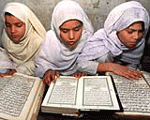
 All religions are first and foremost traditions. There is nothing intrinsically modern about religion. Like the institution of family, religion is also a traditional institution. Out of all living religions, Muslims are still arguably closest to their religion and constitute the last remaining frontier that modernism vies to engulf and dissolve.

